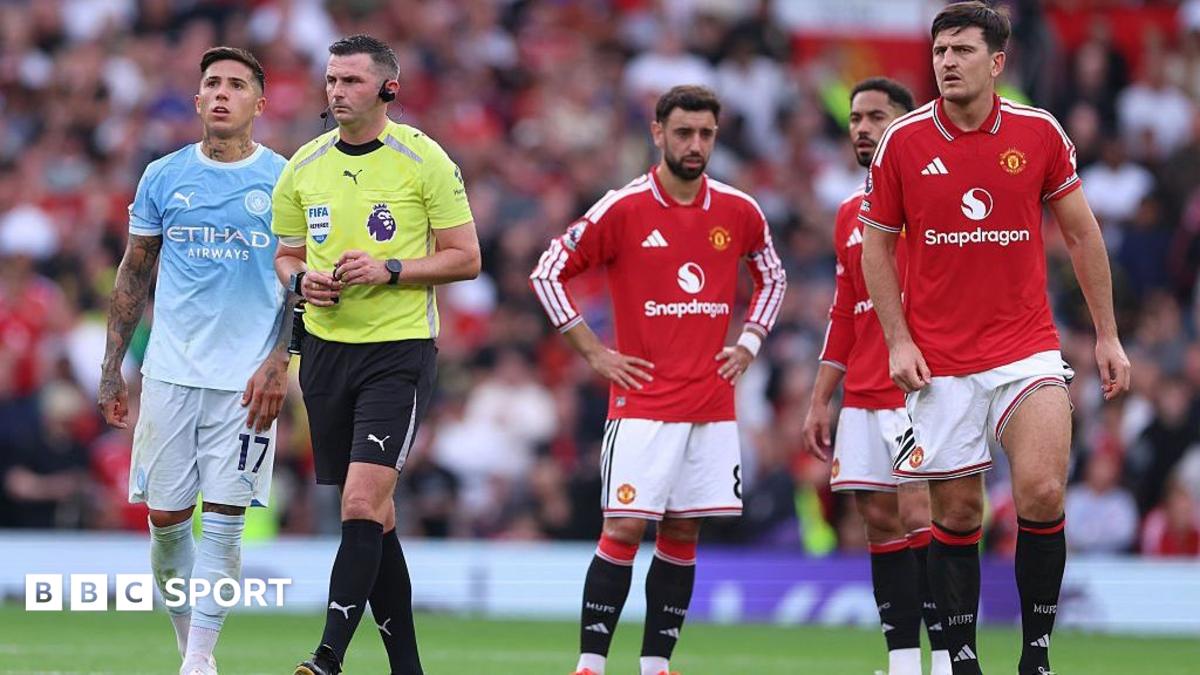

The Manchester Derby VAR howler wasn't a failure of technology. It was a failure of the law itself.
When Matt Donohue missed Enzo Fernandez standing three yards offside before Erling Haaland's winner, the outcry was predictable. But the real scandal isn't the missed call. It's that the offside rule has become so convoluted that even professional officials cannot apply it consistently. VAR didn't fail. The rulebook did.
Offside was once a simple, brutal law
For most of football history, offside was binary. You were either ahead of the last defender or you weren't. Linesmen made split-second calls. Everyone accepted the margin of error because the law was clear.
Then came the reinterpretations. Active and passive. Interfering with play. Gaining an advantage. Phases of play. Each clarification added another layer of subjectivity. By the time VAR arrived, the offside law had become a legal document requiring a philosophy degree to decode.
The Enzo Fernandez incident is the logical endpoint. He was three yards offside. Not marginal. Not a toenail. Three yards. And yet the VAR official hesitated because he had to determine whether Fernandez was interfering with play, whether he was in the goalkeeper's line of sight, whether the phase of play had reset. In that fog of interpretation, a blatant offside was missed.
The same confusion has infected other decisions. Last season, Brighton had a goal ruled out at Crystal Palace because a player was deemed offside despite being on the floor with his back to goal. The season before, Wolves were denied a winner at Liverpool when a player in an offside position was judged to have interfered with play despite being nowhere near the ball.
These aren't technology failures. They're law failures. VAR has simply exposed them on a loop.
The offside law needs a hatchet, not a tweak
The solution isn't more VAR training or faster line-drawing. It's simplifying the law to the point where the only question is: was the attacker ahead of the second-last defender when the ball was played? No active. No passive. No interfering. Just position.
Would that mean some goals are ruled out for offside that currently stand? Yes. Would some goals stand that are currently ruled out? Also yes. But it would be consistent. And consistency is what football craves.
- The Enzo Fernandez miss: three yards offside, yet the VAR hesitated because he had to judge interference, not position.
- Brighton's disallowed goal at Crystal Palace: player on the floor, back to goal, still adjudged to be interfering. Absurd.
- Wolves at Liverpool: a player nowhere near the ball ruled to have gained an advantage. The law is a joke.
- Arsenal's goal at Aston Villa last season: six passes after the offside, still disallowed because the phase hadn't reset. Nobody in the stadium understood why.
None of those decisions required a new camera angle. They required a clear law. The current one isn't clear. It's a labyrinth.
The counter-argument: simplification would ruin the game
The standard defence of the current law is that a strict offside rule would punish attackers for incidental positions that don't affect play. A striker standing offside by the corner flag shouldn't nullify a goal, the argument goes.
That's a fair point in theory. But in practice, the current law creates far more injustice than it prevents. The Enzo Fernandez error cost Manchester United a derby. The Brighton disallowed goal cost them a point at Selhurst Park. The Wolves decision cost them a famous win at Anfield.
How many more games must be decided by legalistic interpretations before we admit the law is the problem? The counter-argument assumes that players will exploit a strict offside law by standing in offside positions to gain an advantage. They won't. Because if they're offside when the ball is played, the flag goes up. No advantage. No ambiguity.
Besides, football already has a mechanism for punishing deliberate offside positioning: it's called the offside trap. Defenders have been using it for over a century. A simplified law would simply restore that duel between attacker and defender. One runs, one steps up. The fastest and smartest wins. That's football, not law.
Prediction: the IFAB will simplify the offside law within two years, and the Premier League will lead the push
The Premier League has already shown a willingness to break from IFAB on handball and concussion protocols. The Enzo Fernandez fiasco will be the catalyst for a formal proposal. I predict that by the start of the 2028-29 season, the offside law will be reduced to a single sentence: a player is offside if any part of their body that can score a goal is ahead of the second-last defender when the ball is played.
No active. No passive. No interfering. Just position. And the VAR officials will finally have a law they can apply without a philosophy degree. When that happens, the Manchester derby error will be remembered not as a VAR failure, but as the moment the game admitted its rules were broken.
Related Articles
Filed under: Opinion | LA Premier League Home