Ipswich Town were Premier League founder members in 1992 — and their top-flight story ends in the 9-0 defeat at Old Trafford
Ipswich Town joined the Premier League as founder members in 1992 and, across two spells, produced one record-breaking relegation, a fifth-placed European qualification and a 22-season exile. This is the club's complete top-flight timeline, from John Lyall's survivors to Kieran McKenna's modern revival.
- Founder members: Ipswich were one of the Premier League's 22 original clubs in 1992/93 under John Lyall.
- First spell: Three seasons, ending with relegation in 22nd place on 27 points in 1994/95.
- Defining low: Manchester United beat Ipswich 9-0 on 4 March 1995, a Premier League record winning margin, with Andy Cole scoring five.
- Best campaign: Fifth place and European qualification immediately after returning in 2000/01 under George Burley.
- The long road: 22 consecutive seasons outside the Premier League, falling as far as League One before McKenna.
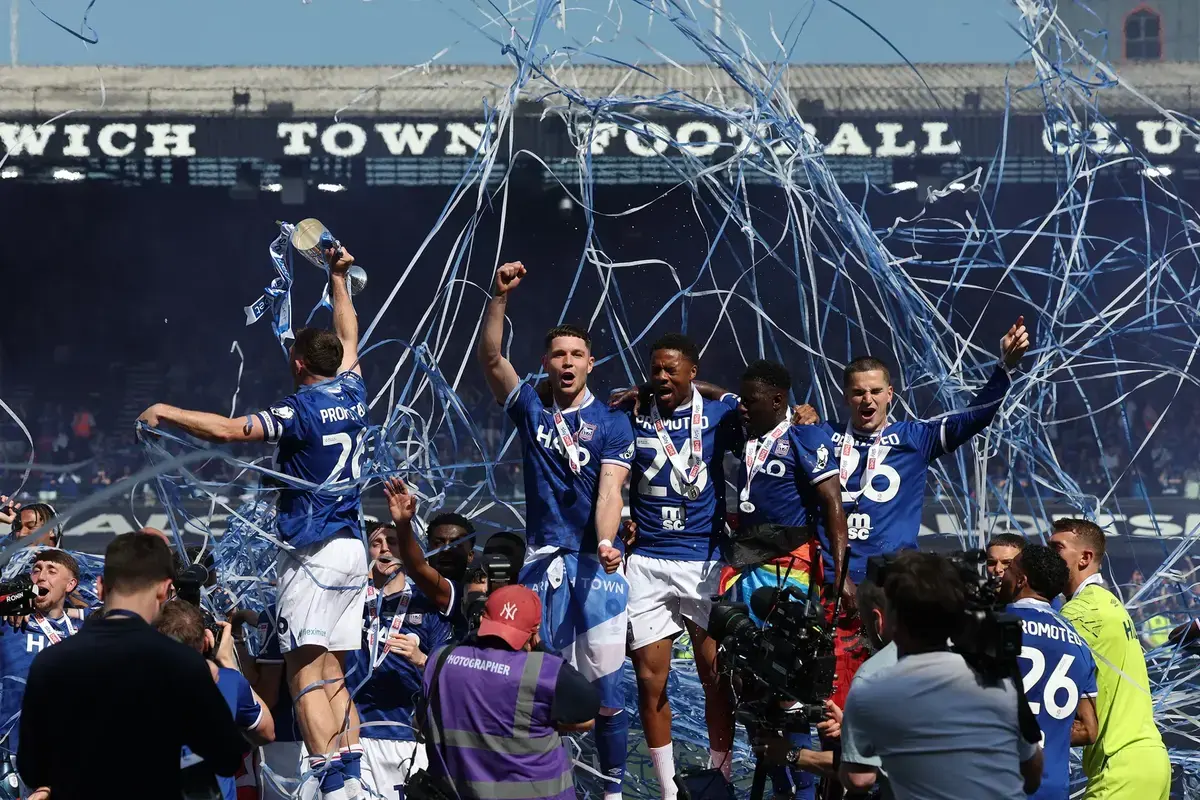
- Modern cycle: Relegated after returning in 2024, then immediately promoted again.
Before the Premier League: Ramsey, Robson and a Second Division title
Ipswich entered the Premier League era with a pedigree few founding clubs could match. Under Alf Ramsey, they won the Second Division title in 1960/61 and were crowned champions of England in their first season back in the top flight, finishing three points clear of Burnley in 1961/62 with 24 wins from 42 matches. Ramsey then left to manage England and led the national team to the 1966 World Cup.
Bobby Robson, appointed in 1969, built a side that regularly challenged near the top of the First Division. Ipswich won the FA Cup in 1978, beating Arsenal 1-0 at Wembley through Roger Osborne's goal, and three years later lifted the UEFA Cup after beating AZ Alkmaar 5-4 on aggregate. They finished second in the First Division in both 1980/81 and 1981/82. Ipswich were relegated in 1986 but returned six years later, winning the final Second Division title under John Lyall — the championship that made them one of the competition's 22 founder members.
1992/93: Founder members survive comfortably
Lyall retained much of his promoted squad, including goalkeeper Craig Forrest, defenders John Wark and David Linighan, midfielder Jason Dozzell and striker Chris Kiwomya. Their first Premier League match ended 1-1 against Aston Villa at Portman Road, with Mick Stockwell scoring Ipswich's first goal in the competition.
The Tractor Boys lost only three of their first 22 league matches and spent part of the winter inside the top six. Their form faded after Christmas, but the strong start provided ample protection. Ipswich finished 16th with 52 points from 42 matches, winning 12, drawing 16 and losing 14, scoring 50 and conceding 55. The season included a 4-2 home win over defending champions Leeds United and a league double over Manchester United — 2-1 at Portman Road and 2-1 at Old Trafford. Kiwomya top-scored with 10 league goals, with Dozzell, Wark and Stockwell contributing from midfield.
1993/94: Survival on the final day
The second season was far harder. Ipswich won only nine of 42 matches and scored 35 times, an average of 0.83 goals per game. Their defensive record kept them competitive — 58 goals conceded, fewer than several teams above them — but a run of draws stopped them pulling clear.
Safety was decided on the final day at Portman Road. Knowing a win would guarantee survival, Ipswich beat title-chasing Blackburn Rovers 2-1. The result lifted them above Sheffield United, who conceded a late goal against Chelsea and were relegated instead. Ipswich finished 19th with 43 points, one clear of the bottom three, with just two away wins and 16 draws — joint-highest in the division. They also reached an FA Cup quarter-final, losing to eventual finalists Chelsea after a replay.
1994/95: Relegation and the 9-0 at Old Trafford
The Premier League shrank from 22 clubs to 20 at the end of 1994/95, meaning four teams would go down — and Ipswich never escaped the bottom of the table. Lyall moved into a director of football role early in the season, with Paul Goddard taking over as manager, but results failed to improve. There were brief highlights: a 4-1 home win over Leicester City in January, with Ian Marshall scoring twice.
The defining result came at Old Trafford on 4 March 1995. Manchester United beat Ipswich 9-0, setting a Premier League record for the largest winning margin. Andy Cole scored five, with Roy Keane, Mark Hughes twice and Paul Ince completing the scoring. Ipswich had beaten Manchester United 3-2 at Portman Road earlier in the season. They finished 22nd and bottom with 27 points, winning seven, drawing six and losing 29 of 42, conceding 93 goals and scoring 36 — 23 points short of safety.
1995 to 1998: Rebuilding under Burley
Ipswich appointed George Burley in December 1994, initially while the club was still in the Premier League. A former Ipswich defender, Burley rebuilt around academy products, lower-league recruits and players capable of developing within the club. Ipswich narrowly missed the play-offs in 1995/96, finishing seventh, then reached the play-offs in each of the next three seasons but repeatedly fell at the semi-final stage. In 1996/97 they finished fourth before losing to Sheffield United on away goals; the following season they finished fifth and were beaten by Charlton Athletic.
The football was often attractive and technically ambitious, but the repeated play-off defeats raised questions about whether Burley's team could convert consistency into promotion. Key players included Richard Wright, Matt Holland, Mark Venus, Tony Mowbray, Mauricio Taricco, James Scowcroft and David Johnson.
1998/99: Bolton end another promotion attempt
Ipswich finished third in the First Division in 1998/99 with 87 points, behind only Sunderland and Bradford City, scoring 69 goals and losing just nine of 46 league matches. The play-offs again brought disappointment. They faced Bolton Wanderers in a semi-final: the first leg finished 0-0 at the Reebok Stadium, leaving Ipswich with home advantage, and the second leg ended 4-4 after extra time. Bolton progressed on away goals — a fourth consecutive season outside the Premier League, and a painful one given Ipswich had assembled a team that appeared ready for the highest level.
Why the timeline still shapes Ipswich today
The pattern across Ipswich's Premier League history is consistent: survival built on defensive organisation and a strong start, followed by a collapse once goals dried up. Lyall's 1992/93 side lost only three of 22 games early on, then finished 16th; the 1993/94 team drew 16 games and needed a final-day win over Blackburn to stay up; 1994/95 offered no such escape.
Burley's rebuild is the other half of the story. By leaning on Richard Wright in goal, Matt Holland in midfield and James Scowcroft and David Johnson up front, Ipswich built a core that kept them near the top of the First Division for years. The play-off record — semi-final defeats to Sheffield United, Charlton and Bolton — explains why the eventual return under Kieran McKenna, and the fifth-placed finish and European qualification that followed the club's second promotion, mattered so much. The 2024 relegation and immediate promotion repeat the cycle: Ipswich are never far from a rise or a fall.
Talking points
- The 9-0 at Old Trafford is remembered as Ipswich's darkest day, but the 1994/95 squad was already 23 points adrift — the collapse was structural, not a single afternoon's freak result.
- Was Burley's attractive football a strength or a trap? Four play-off failures suggest Ipswich were building for the First Division rather than the Premier League.
- Finishing fifth after promotion remains the benchmark for any newly promoted club — and Ipswich followed it with relegation 12 months later, which says everything about the fragility of that model.
- McKenna's successive promotions, relegation and immediate return mirror the club's entire history: short, sharp rises followed by sudden falls.
What happens next
Ipswich's most recent cycle — relegation in 2024, then immediate promotion under McKenna — means the club's next Premier League campaign will be judged against the 2000/01 benchmark of fifth place rather than mere survival. The first task is turning a founder member's history of yo-yo seasons into a sustained stay.
Frequently asked questions
Were Ipswich Town founder members of the Premier League?
Yes. Ipswich won the final Second Division title under John Lyall and were one of the competition's 22 founder members in 1992/93.
What was Ipswich's heaviest Premier League defeat?
The 9-0 loss at Manchester United on 4 March 1995, a Premier League record winning margin, with Andy Cole scoring five.
How many seasons did Ipswich spend outside the Premier League?
22 consecutive seasons, falling as far as League One before Kieran McKenna led the club back through successive promotions.
Related Articles
Filed under: Club News | LA Premier League Home