Hull City beat Arsenal and Tottenham in 2008/09 — and still needed the final day to survive
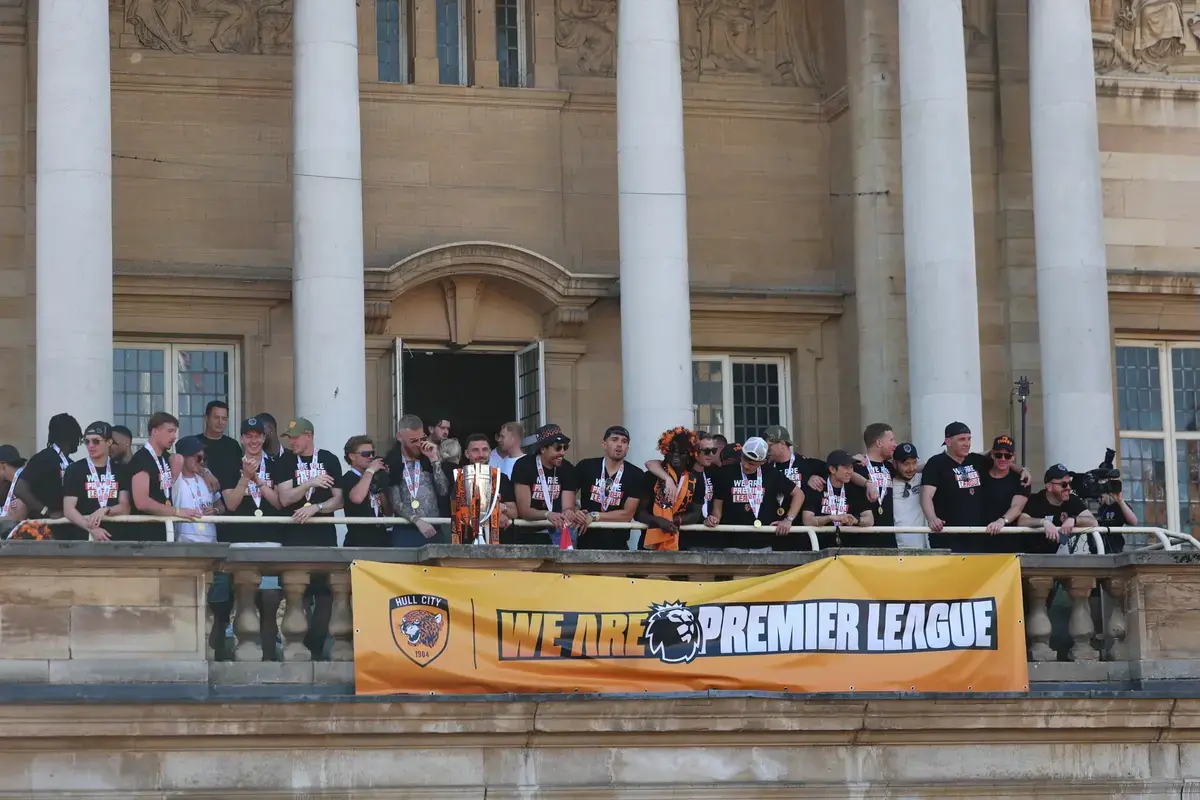
Hull City waited 104 years to reach the Premier League in 2008, then delivered one of the most eventful eras any promoted club has produced: a top-three start, a last-day escape, relegation, an FA Cup final and European qualification under Steve Bruce, and a 2026 play-off return after nine years away.
- First promoted: 2008 via the Championship play-offs, beating Bristol City 1-0 at Wembley
- Decisive goal: Dean Windass volley, 38th minute, aged 39
- Best opening: 20 points from nine games in 2008/09, third in the Premier League
- Survival: Finished 17th with 35 points, one ahead of Newcastle United
- Latest return: 2026 play-off victory after nine years outside the top flight
- Competition: Premier League
The century before the Premier League
Hull City were formed in 1904 and elected to the Football League a year later. The club came closest to the First Division in 1909/10, finishing level on points with Oldham Athletic but missing out on goal average — the nearest Hull would get to the top level for almost a century.
Much of their history was spent moving between the second and third tiers. They won the Third Division North in 1932/33 and 1948/49, then secured another promotion from the third level in 1958/59. The 1960s brought the strongest spell: Hull won the Third Division title in 1965/66 after scoring 109 league goals, with Chris Chilton and Ken Wagstaff leading an outstanding attack, and stayed in the second tier for the next 12 seasons.
Decline took them into the Fourth Division in 1981, when the club was also placed into receivership and came close to financial collapse. Two promotions in three seasons followed, climbing from the fourth tier in 1982/83 and reaching the Second Division in 1985. Another slump during the 1990s left Hull back in the fourth tier by 1996 — matters became so serious that the club was briefly locked out of Boothferry Park during a dispute involving the stadium's ownership. The move to the KC Stadium in 2002, later renamed the KCOM Stadium and then the MKM Stadium, provided the foundation for a dramatic recovery.
From the fourth tier to the Championship
Hull reached the Third Division play-offs in 2000/01 but lost to Leyton Orient in the semi-finals. After moving into their new stadium, the Tigers progressed rapidly under Peter Taylor, finishing second in the Third Division in 2003/04 with 88 points. Ben Burgess scored 18 league goals, while Stuart Elliott, Ian Ashbee and Justin Whittle were central figures.
They immediately won another promotion, finishing second in League One in 2004/05 with 86 points and 80 league goals, Elliott contributing 27. Successive promotions took Hull from the fourth tier to the Championship in only two seasons.
Dean Windass at Wembley
Hull's first Championship campaign ended 18th, survival secured by 10 points, but the following season proved difficult. Taylor left for Crystal Palace in the summer of 2006 and Phil Parkinson was appointed, with a significant recruitment programme that produced poor results. Parkinson was dismissed in December with Hull in the relegation zone, and Phil Brown, initially caretaker, received the job permanently. Hull finished 21st, one place and eight points above the relegation zone, with Dean Windass crucial after returning to his hometown club on loan from Bradford City — a move later made permanent.
In 2007/08, Brown built a team around experience, physical strength and players developed during the club's rise. Ashbee captained the side, Boaz Myhill provided stability in goal, Michael Turner developed into one of the Championship's strongest central defenders and Fraizer Campbell, on loan from Manchester United, scored 15 league goals. Windass added 13 despite turning 39 during the campaign.
Hull finished third with 75 points behind West Bromwich Albion and Stoke City, beat Watford 2-0 at Vicarage Road and 4-1 at home for a 6-1 aggregate semi-final success, then faced Bristol City at Wembley. In the 38th minute Campbell controlled a pass and found Windass on the edge of the penalty area, and the veteran struck a brilliant right-footed volley into the top corner. Hull won 1-0 — Windass was 39, and his goal took his hometown club into the top division for the first time in its 104-year history.
2008/09: Geovanni at the Emirates and a final-day escape
Hull's first Premier League match was against Fulham at the KC Stadium. Seol Ki-hyeon gave Fulham the lead, Geovanni equalised and Caleb Folan scored the winner in a 2-1 victory. It was not an isolated surprise: the Tigers lost only one of their opening nine matches, defeating Newcastle United, Arsenal, Tottenham Hotspur and West Bromwich Albion.
The 2-1 win at Arsenal was the standout. Paul McShane's own goal put Hull behind at the Emirates, Geovanni equalised with a spectacular long-range strike and Daniel Cousin headed the winner from a corner. A week later Hull won 1-0 at Tottenham, Geovanni again decisive with a long-range free kick. After nine matches Hull had 20 points and were third.
The momentum did not last. Opponents adjusted, injuries reduced Brown's options and the squad struggled to maintain its early physical intensity. A 5-1 defeat at Manchester City on Boxing Day became one of the season's defining moments — Hull were 4-0 down at half-time when Brown delivered his team talk on the pitch, in front of the travelling supporters.
The Tigers won only two of their final 29 league matches. Survival came down to the final day: Hull hosted Manchester United knowing Newcastle could move above them. Darron Gibson scored the only goal as Hull lost 1-0, but Newcastle were also beaten 1-0 at Aston Villa. Hull finished 17th with 35 points, one ahead of Newcastle, having won eight, drawn 11 and lost 19, scoring 39 and conceding 64. Geovanni finished as leading league scorer with eight goals.
The numbers
- 20 points and third place after nine matches in 2008/09
- Two wins in the final 29 league matches of that season
- 35 points, 17th place — one clear of Newcastle United
- Eight wins, 11 draws, 19 defeats; 39 scored, 64 conceded
- Geovanni: eight league goals, the club's leading scorer
- 109 league goals in the 1965/66 Third Division title season
- 88 points (2003/04) and 86 points (2004/05) in successive promotions
The financial collapse of 2009/10
Hull attempted to strengthen for their second Premier League season, bringing in Stephen Hunt, Steven Mouyokolo, Seyi Olofinjana and Kamel Ghilas, while Jimmy Bullard returned after missing much of the previous campaign with a serious knee injury. The season quickly became difficult: Hull lost 5-1 at home to Tottenham in their second match and were beaten 6-1 at Liverpool, and relegation followed amid serious financial problems.
Bruce, the FA Cup final and Europe
Hull returned under Steve Bruce, reached an FA Cup final and qualified for Europe, with Tom Huddlestone's FA Cup semi-final goal among the defining moments of that era. Another relegation followed, along with a second play-off victory and a turbulent final Premier League campaign in 2016/17, which included Marco Silva's rescue attempt.
Why the 2008/09 collapse is the real lesson
The most revealing detail in Hull's timeline is not the Geovanni winner at the Emirates but the run that followed. Geovanni and Daniel Cousin gave Brown's side a direct, physical identity that opponents had not prepared for; once they adjusted, and once injuries thinned the squad, Hull had no second method. Winning two of 29 matches is what happens when a newly promoted team's gameplan is scouted and its intensity cannot be sustained.
That pattern matters for the 2026 vintage. The club has already shown, under Bruce, that a more structured build can reach an FA Cup final and qualify for Europe — proof that Hull's ceiling is higher than a survival scramble. The mistake to avoid is treating an encouraging start as proof of safety, exactly as 2008/09 invited everyone to do.
Hull's history also shows how quickly a club can fall: from the Premier League to League One before rebuilding again. The 2026 play-off campaign, and the return after nine years away, is the third full rebuild of the modern era. Each previous one was built on a settled core — Ashbee, Myhill and Turner in 2007/08 — rather than a scattergun summer.
Talking points
- Was the Windass volley the greatest goal in Hull's history, or does Geovanni's strike at the Emirates matter more because it proved the club belonged?
- Brown's on-pitch half-time team talk at Manchester City is remembered fondly — but a 5-1 Boxing Day defeat was the point the season turned.
- Hull's 20 points from nine games in 2008/09 remains one of the great promoted-club starts; the collapse that followed is the cautionary tale.
- Reaching an FA Cup final and qualifying for Europe under Bruce should be the benchmark for the 2026 side, not mere survival.
What happens next
Hull are back in the Premier League after a nine-year absence, and the immediate task is to avoid the 2009/10 pattern: strengthening without losing the identity that earned promotion. The first fixtures of the new campaign will show whether this squad has the second method that the 2008/09 side lacked.
Frequently asked questions
Who scored Hull City's goal in the 2008 play-off final?
Dean Windass scored the only goal in the 38th minute, a right-footed volley, as Hull beat Bristol City 1-0 at Wembley. He was 39 years old.
How did Hull City survive in 2008/09?
Hull lost 1-0 at home to Manchester United on the final day through Darron Gibson's goal, but Newcastle United also lost 1-0 at Aston Villa, leaving Hull 17th on 35 points, one ahead of Newcastle.
When did Hull City return to the Premier League?
In 2026, after completing another play-off campaign and returning to the Premier League following nine years away.
Related Articles
Filed under: Club News | LA Premier League Home