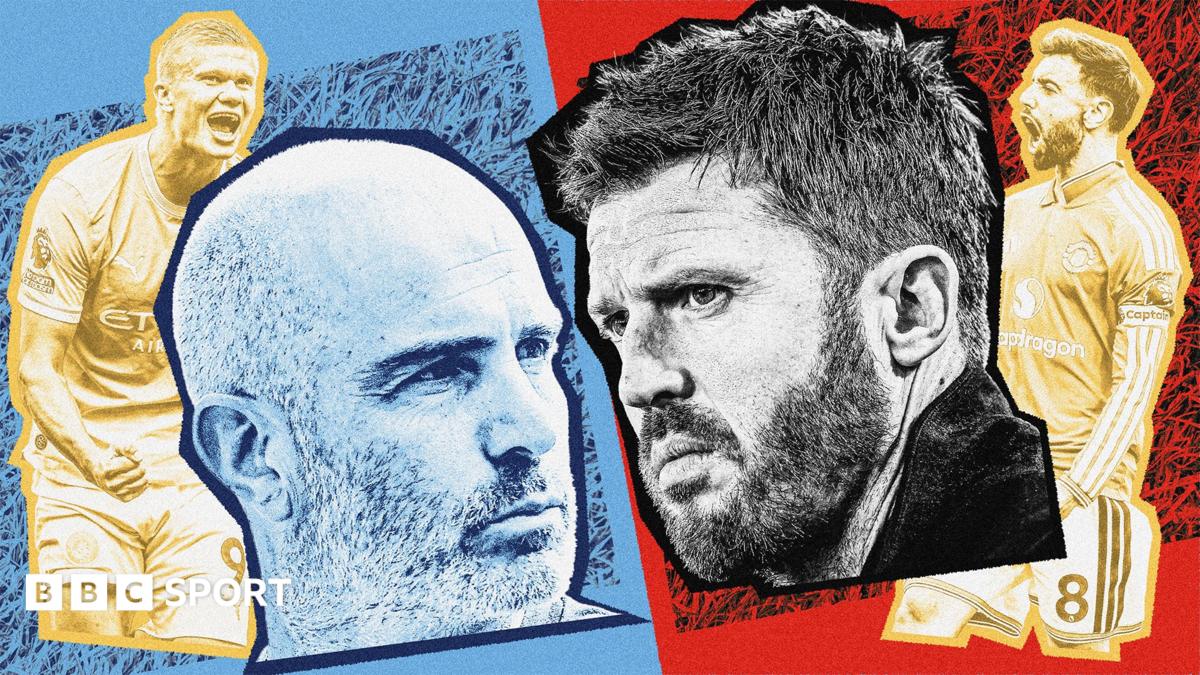
Manchester derby: Enzo Maresca's rigid 3-2-5 Manchester City against Michael Carrick's fluid Manchester United
Manchester City and Manchester United meet in Sunday's Manchester derby with diametrically opposed gameplans. City boss Enzo Maresca, inspired by Pep Guardiola, uses a fixed structure with precisely positioned players. United counterpart Michael Carrick allows more freedom within positional guidelines. Here is how both systems work.
- Fixture: Manchester derby, Sunday
- Manchester City approach: Rigid structure, players precisely positioned, 3-2-5 or 3-1-3-3 shape on the ball
- Manchester United approach: Fluid, positional guidelines but freedom to roam, deeper midfielders form back three
- Key quote (Maresca): "If the freedom for you is that you can move everywhere, that is not freedom, that is chaos."
- Key quote (Carrick on Kobbie Mainoo): "Really conscious of not giving him an awful lot of instructions."
- At stake: Two clubs five miles apart, both aiming to return to the top of the Premier League
How Carrick's United use positional ideas
United keep their two centre-backs in fixed positions. The deepest midfielder helps in build-up, either in a narrow midfield two or by dropping deep to create a back three. If a back three forms, the second midfielder holds the centre alone.
The full-backs begin in natural left and right positions. Higher up, they may join the attack, positioning themselves based on the winger — one out wide, one more central. The number 10 and striker drop deep, forming a fluid front two at times.
Why United's shape works
With the holding midfielder dropping to form a temporary back three, United can overload teams that press with two strikers. Against narrow opponents, wide full-backs stretch play, while Carrick's men often look to play through the middle instead — something they appear coached to do.
Full-backs entice narrow opponents wider. Concerned by their threat, the opposition may shift, freeing space for passes into central midfielders. The central clusters also help United crowd around the ball if it is lost, aiming to win it back.
What was said
"If the freedom for you is that you can move everywhere, that is not freedom, that is chaos."
"[Our] freedom? You can do what you want in the position you receive the ball."
I [was] really conscious of not giving him an awful lot [of instructions]. A couple of little pointers, a few positional things, but to trust in what he is. He's a fantastic footballer.
Maresca's view of freedom is strictly positional: players act freely only within their assigned zone. This contrasts with Carrick, who trusts players to make decisions within a shared tactical framework. The Italian's approach reduces uncertainty and relies on drilled solutions. Carrick's allows unpredictability but demands greater interpretation.
Carrick's comments on Mainoo underline his philosophy. He gives minimal instructions, preferring players to express themselves. That trust can unlock defences but also leads to chaotic moments. Maresca's chess-like comparison to football suggests he prioritises control above all.
How Carrick and Maresca view player freedom
United's players can move freely from their starting positions. If Bruno Fernandes or Matheus Cunha decide to move closer to the ball or the touchline, they will. Central defenders then face a dilemma: follow them or hold position. If unmarked, United often outnumber the opposition around the ball, easing pressure. If marked, space opens in the middle for another player.
United's players then interpret a more chaotic picture, deciding in the moment rather than following a script. Maresca's Manchester City occupy specific zones in their 3-2-5 or 3-1-3-3 shape on the ball, making them more predictable but ensuring each player knows their role. After City's win against Coventry, Maresca said Iliman Ndiaye had minimal training time, which meant he sometimes "was moving in the wrong way [into the] wrong position" for how City intend to play.
Fixed positioning offers execution speed that can be hard to stop, and less spontaneous thinking is required to unlock defences as solutions are drilled through repetition.
How Carrick introduces order within his more free system
United have established shared tactical principles: clustering around the ball, attracting pressure, then finding players in space quickly. Unlike Maresca's specific solutions, United's players often decide when and where to use what they have been taught.
Carrick's side look to escape pressure through trios of players passing between each other. As one player receives, a team-mate moves to become the next option. These triangles are not fixed but created when players feel the moment is right. In pre-season against AC Milan, United played good combinations in threes, using third-man runs. A vertical pass into Bruno Fernandes dropping deep was noticed by central midfielder Youri Tielemans.
This shared tactical language gives clarity while remaining unpredictable for defenders.
The pros and cons of both approaches
Every approach has positives and negatives. City's rigid structure makes them predictable but difficult to stop due to precise execution. United's fluidity creates unpredictability but can lead to disorganisation. Both managers have clear philosophies, and Sunday's derby will show which prevails.
Talking points
- Maresca's fixed system may be predictable, but City's drilled movements are designed to overwhelm regardless of what opponents know.
- Carrick's trust in players like Bruno Fernandes to roam could exploit City's rigid zones, but risks leaving United exposed.
- Can United's midfield clustering around the ball overcome City's positional dominance in the centre of the pitch?
- Maresca's public definition of freedom as chaos might backfire if his players lack the skill to execute his demanding system.
What happens next
The Manchester derby on Sunday will provide the first real test of Maresca's fixed structure against Carrick's fluidity. City aim to assert control, while United will look to disrupt and exploit space. Both clubs are desperate to return to the top of the Premier League, and this match could set the tone for the season.
Frequently asked questions
What formation does Manchester City use under Enzo Maresca?
Manchester City use a rigid 3-2-5 or 3-1-3-3 shape on the ball, with players occupying specific zones.
How does Michael Carrick's Manchester United system differ?
United use positional guidelines but allow more freedom, with the deepest midfielder dropping into a back three and attackers like Bruno Fernandes and Matheus Cunha roaming.
What did Enzo Maresca say about freedom in football?
Maresca said: "If the freedom for you is that you can move everywhere, that is not freedom, that is chaos." He defines freedom as doing what you want in the position you receive the ball.
Related Articles
Filed under: Tactical Analysis | LA Premier League Home