Only 8.6% of Premier League teams trailing at half-time go on to win, study of 4,180 matches finds
A comprehensive analysis of 4,180 Premier League matches from 2015/16 to 2025/26 shows that teams behind at half-time win just 8.6% of the time. Manchester City have the best comeback rate, while Bournemouth's 4-3 win over Luton Town remains the only three-goal turnaround.
- Study scope: 4,180 finished Premier League matches across 11 seasons (2015/16–2025/26)
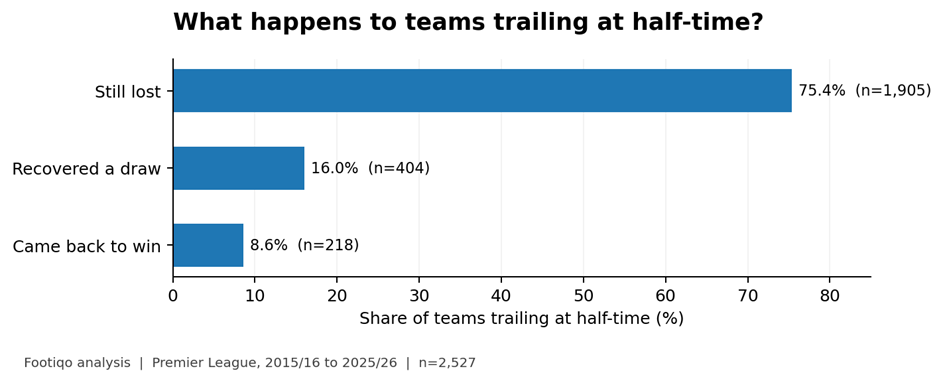
- Comeback win rate: 8.6% – 218 wins from 2,527 half-time deficits
- Draw rate: 16.0% (404 matches); defeat rate: 75.4% (1,905 matches)
- Best club rate: Manchester City – 22.0% (13 wins from 59 deficits)
- Rarest comeback: Bournemouth 4-3 Luton Town on 13 March 2024, the only win from a 3+ goal half-time deficit
- Home advantage: Home teams win 11.1% when trailing at half-time vs 6.8% for away teams
The numbers
- Total matches analysed: 4,180 (380 per season)
- Matches with a half-time leader: 2,527
- Matches level at half-time: 1,653 (excluded from comeback-rate calculations)
- Comeback wins: 218 (8.6% of 2,527)
- Recovered draws: 404 (16.0%)
- Defeats: 1,905 (75.4%)
- Home teams trailing: 1,078 matches – 120 comeback wins (11.1%)
- Away teams trailing: 1,449 matches – 98 comeback wins (6.8%)
- Home teams salvaging at least a draw: 28.3%
- Away teams salvaging at least a draw: 21.9%
- One-goal deficit: 200 wins from 1,758 (11.4%)
- Two-goal deficit: 17 wins from 594 (2.9%)
- Three-or-more-goal deficit: 1 win from 175 (0.6%)
- Manchester City: 13 wins from 59 deficits (22.0%)
- Liverpool: 15 wins from 76 deficits (19.7%)
- Manchester United: 17 wins from 95 deficits (17.9%)
- Tottenham Hotspur: 17 comeback wins – joint-highest total with Manchester United
- Most comebacks in a season: 2024/25 – 29 wins from 245 (11.8%)
- Fewest comebacks in a season: 2016/17 – 12 wins from 227 (5.3%)
- 2025/26 season: 23 comeback wins from 236 half-time deficits (9.7%)
Manchester City lead comeback success rate as Liverpool and Manchester United trail
Among clubs that trailed at half-time on at least 50 occasions, Manchester City achieved the highest comeback-win rate. Manchester City won 13 of 59 matches when behind at the break (22.0%). Liverpool followed with 15 wins from 76 deficits (19.7%), while Manchester United recorded 17 wins from 95 (17.9%).
In absolute numbers, Manchester United and Tottenham Hotspur shared the highest total, with 17 comeback victories each. The divergence between success rate and raw totals reflects different numbers of half-time deficits and varying seasons in the league.
Home advantage and deficit size shape comeback chances
When the home side trailed at half-time, it recovered to win 120 of 1,078 matches (11.1%). Away teams managed only 98 wins from 1,449 matches (6.8%) – a gap of 4.4 percentage points. Home teams were also more likely to salvage at least a draw: 28.3% compared with 21.9% for away teams.
The size of the deficit is even more decisive. Teams one goal down at half-time won 200 of 1,758 matches (11.4%). With a two-goal deficit, the comeback-win rate plummeted to 17 out of 594 (2.9%). Only one team in the entire sample won after being three or more goals behind at half-time – across 175 such matches, a rate of 0.6%.
2024/25 was the standout season for comebacks
The most comebacks in a single season came in 2024/25, when 29 of 245 teams trailing at the break went on to win (11.8%). At the other end, 2016/17 saw only 12 wins from 227 such situations (5.3%). There was variation from season to season rather than a consistent upward trend. The 2025/26 campaign recorded 23 comeback wins from 236 half-time deficits (9.7%), below the 2024/25 peak.
Bournemouth's 4-3 win over Luton Town remains the rarest turnaround
On 13 March 2024, Bournemouth went into half-time 3-0 down at home to Luton Town. They won 4-3. In the 4,180-match sample, it was the only victory by a side trailing by at least three goals at the interval. Other striking reversals came from two goals down: Manchester United overturned a 2-0 half-time deficit to beat Manchester City 3-2 away on 7 April 2018, and Manchester City themselves came back from 2-0 down to defeat Tottenham 4-2 on 19 January 2023. Such matches are memorable precisely because the wider data shows how infrequently they happen.
Why the half-time deficit is so rarely overturned
The data confirms that a half-time lead is a substantial advantage, but not a guarantee. The size of the gap is critical: overturning a one-goal deficit is around four times as common as overturning a two-goal deficit. Venue also correlates with the likelihood of a full comeback, with home teams significantly more likely to fight back.
These historical associations do not prove that the venue alone causes a comeback; opponent strength and match circumstances also matter. Crucially, these figures describe past Premier League results and should not be treated as forecasts for any particular fixture. Team quality, injuries, match dynamics and other factors may differ.
Talking points
- Manchester City's 22% comeback rate suggests their squad depth and tactical flexibility make them the most dangerous team when trailing – is that a mindset or a quality issue?
- With only one win from 175 matches when three or more goals down at half-time, should managers prioritise damage limitation over unlikely comebacks?
- Home advantage adds over four percentage points to comeback chances – does that mean crowd support genuinely influences player psychology, or is it a statistical quirk?
- Manchester United and Tottenham share the highest raw number of comeback wins (17 each), yet United's rate is lower – does that expose inconsistency rather than resilience?
What happens next
The 2025/26 Premier League season continues, with every match providing fresh data for future analysis. The next round of fixtures will test whether the 9.7% comeback rate so far this season holds or whether another dramatic turnaround – like Bournemouth's against Luton – emerges. Clubs trailing at half-time will aim to defy the historical odds, but the numbers suggest most will not.
Frequently asked questions
How often do Premier League teams win after trailing at half-time?
Teams trailing at half-time win 8.6% of the time, according to an analysis of 4,180 Premier League matches from 2015/16 to 2025/26. That equates to roughly one comeback win in every 12 opportunities.
Which Premier League club has the best comeback record from half-time?
Manchester City have the highest comeback-win rate among clubs with at least 50 half-time deficits, winning 22.0% of such matches (13 wins from 59). Liverpool (19.7%) and Manchester United (17.9%) follow.
What is the biggest half-time comeback in Premier League history?
In the studied sample, Bournemouth's 4-3 victory over Luton Town on 13 March 2024 is the only instance of a team winning after trailing by three or more goals at half-time. They were 3-0 down at the break.
Related Articles
Filed under: Tactical Analysis | LA Premier League Home