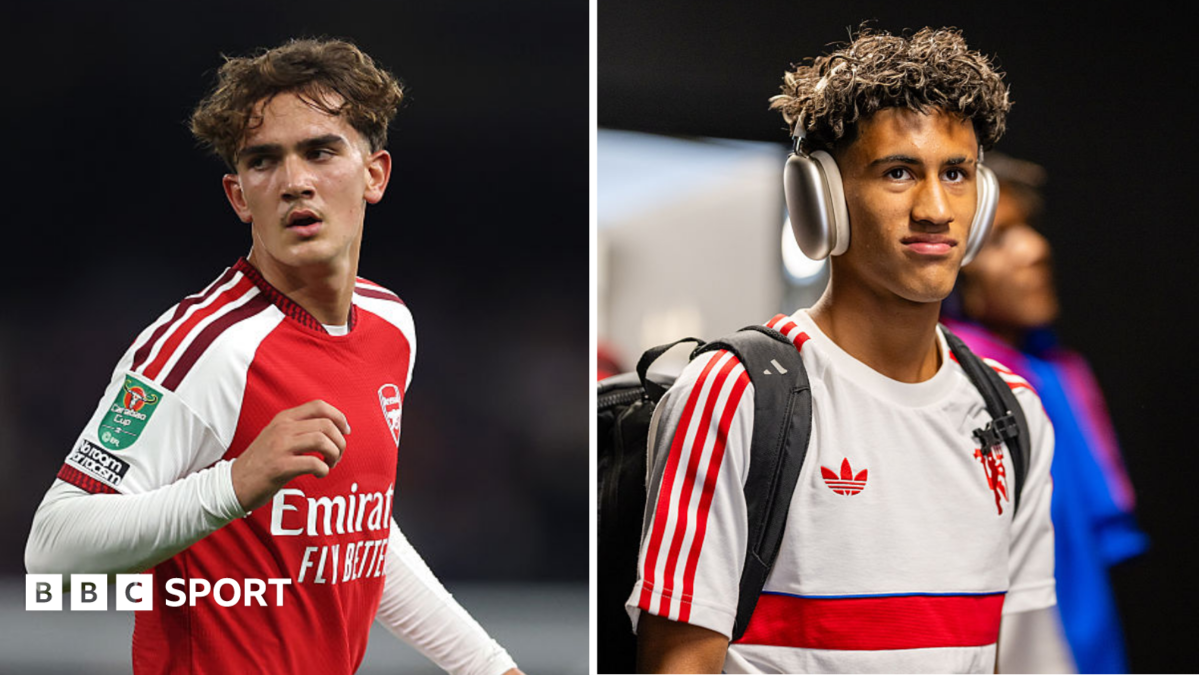
Max Dowman and JJ Gabriel highlight the Premier League's academy rulebook
Arsenal's Max Dowman, 16, scored twice in a 4-2 EFL Cup win at Ipswich, while Manchester United's JJ Gabriel, 15, has asked to leave. Both cases turn on the Premier League's academy rules covering minimum age, scholarships, pay and schooling.
- Minimum age: A player can make a senior appearance in the season or school year they turn 16, meaning Year 11 in England and Wales.
- Dowman's feat: The 16-year-old scored twice in Arsenal's 4-2 EFL Cup third-round win at Ipswich Town on Tuesday.
- Gabriel's request: The 15-year-old Manchester United striker has handed in a formal request to leave, despite playing for the first team in pre-season.
- Professional contracts: Can be offered from the season a player turns 16; signed only from their 17th birthday.
- Long odds: A 2024 University of Essex study found just 4% of teenagers in professional academies reach top-flight football.
The rules explained
What is the minimum age for a senior appearance?
The minimum age for a senior appearance in the Premier League is the season or school year in which that player will turn 16. In England and Wales school terms, the player must be in Year 11 before they can make a senior appearance. Arsenal winger Dowman made his first Premier League appearance at the start of last season as a 15-year-old because he was turning 16 later in the campaign. Fellow wingers Ethan Nwaneri and Jeremy Monga also made their league debuts at 15, both turning 16 later in that school year. United forward Gabriel was not allowed to make his senior debut last season and can only do so this season, as he turns 16 next month.
How are youth players tied to the club?
In England, the academy system grades all participating clubs from Category 1 to Category 4. Clubs in a higher category have the right to sign any player from a lower category for a structured compensation fee, so Category 1 can sign any player from a club in Category 2 to 4. Youth players officially become contracted to a club when first signing a scholarship. Before that, fewer rules bind them to a specific club, although a team holds the player's registration rights if they have been registered for that particular season. To play first-team football in the Premier League, that player must have a scholarship agreement with the club. Players cannot be offered their first professional contracts until the season that they will turn 16, and cannot sign a professional contract until the day of their 17th birthday.
Do youth players get paid?
Upon signing a scholarship contract, youth players are paid a wage structured around an apprenticeship model. Some youth footballers who play for a club in a different country or part of the country than where their family is from are placed into accommodation with local families that work with that club to look after young footballers. These are often known as 'digs'. For players not in digs and living at home with their own families, some clubs give teenage players money to cover expenses such as accommodation and food.
What about school?
It is common for many club academies to offer educational programmes for their academy players, ensuring they balance football with academic studies and gain valuable qualifications. Some clubs put their own schools inside their academy training facilities, while others partner with local schools or have agreements with that player's existing school to balance educational work with football development. A 2024 study from the University of Essex shows that just 4% of teenagers in professional academies go on to play top-flight football. Because of that, clubs across the country ensure their players have more options for their career, should their hopes of making it as a professional footballer not go to plan. As well as studying core subjects such as English, maths and science, clubs have recently added further studies for their academy footballers that include life skills, media, financial education and driving lessons to set them up for whatever comes after their life as an academy player.
What was said
"We as clubs - with education, welfare - have got to make sure that those lads' academic potential is not hampered. It would be it ethically immoral if we just said 'okay you know you stay with us for four, five, six years. You can do as little as you want education wise', then we can't guarantee a professional contract, and then where's the kid?"
"To keep them coming out of school at 16, during that really, really important year, it's wrong. Now there will be odd times, like the Max Dowmans and J.J. Gabriels of this world who are outliers, because they are top of the tree. But with Max Dowman, for instance. Max Dowman did his GCSEs and Arsenal have been absolutely brilliant amongst that, and he's come out with great grades. So you can do it."
Ord's comments underline the welfare-first approach that clubs are expected to take. He personally limited how much schoolwork players missed during their GCSE year, yet pointed to Dowman as proof that elite talents can succeed in both areas.
The contrast with Gabriel, who has formally requested to leave Manchester United, shows how quickly a teenager's pathway can shift. United must now manage a player who has already featured in pre-season but remains bound by scholarship and age rules.
What other rules are there?
For safeguarding purposes, players under the age of 18 are not allowed to get changed in the same dressing room as senior players, so they use an alternative changing area. Clubs must ensure youth players have a designated shower room monitored by an official chaperone such as a player liaison officer or a member of the club's safeguarding team. For clubs with fewer staff in lower divisions, other nominated staff members can fill this role provided they are DBS-registered. Players younger than 18 are also not permitted to wear shirts that have gambling sponsors on them. This has recently become easier for Premier League clubs now that gambling sponsors are prohibited from being the front-of-shirt sponsor. Other provisions include ensuring player safety in team transport and making sure young players are not near alcohol when senior players are consuming it. Players under 18 are also exempt from the new 10 second sub rule, which requires players to leave the field at the nearest point. For safeguarding reasons, they should always leave at the half-way line by the dugouts.
Analysis: why the academy rulebook matters more than ever
Max Dowman and JJ Gabriel are the outliers Simon Ord describes, but the rules that govern them apply to thousands of academy players. Dowman's brace against Ipswich came in the EFL Cup, yet his Premier League debut at 15 was permitted because he was in the school year he turned 16. That same provision will allow JJ Gabriel to make his senior United debut this season, if he stays, once he turns 16 next month.
The category system gives Category 1 clubs like Arsenal and Manchester United a structural advantage: they can sign talent from lower-category academies for compensation fees. But it also creates pressure. Gabriel's formal request to leave shows that even the most promising scholars can force a move before signing professional terms.
Clubs must therefore balance football development with education. The 4% statistic from the University of Essex is a stark reminder that most academy players will not make it. Arsenal's handling of Dowman's GCSEs, praised by Ord, is the model: elite training alongside academic achievement, not instead of it.
Talking points
- Should clubs allow 15-year-olds to make senior debuts, or does the Year 11 rule protect them enough?
- Gabriel's request to leave United raises questions about how much power scholars should have before professional contracts.
- Is the Category 1 compensation system fair to lower-league academies that develop talent only to lose it?
- With just 4% of academy players reaching top-flight football, are clubs doing enough to prepare teenagers for life outside the game?
What happens next
Gabriel turns 16 next month, which will make him eligible for a senior Premier League debut if he remains at Manchester United. His formal request to leave will force the club into a decision over his future. Dowman, meanwhile, continues to balance GCSE results with first-team opportunities at Arsenal. Both cases will test the academy rules.
Frequently asked questions
Can a 15-year-old play in the Premier League?
Yes, if they are in the school year in which they turn 16. In England and Wales, that means Year 11. Arsenal's Max Dowman made his Premier League debut at 15 because he was turning 16 later that season.
When can a Premier League academy player sign a professional contract?
Players cannot be offered their first professional contract until the season they turn 16, and cannot sign one until the day of their 17th birthday. Before that, they are on scholarship terms.
What is the 10 second sub rule and does it apply to under-18 players?
The 10 second sub rule requires players to leave the field at the nearest point. Players under 18 are exempt for safeguarding reasons and must leave at the half-way line by the dugouts.
Related Articles
Filed under: Club News | LA Premier League Home